Why four ways
Why four kinds of practice, not ten repetitions
Writing ten spelling words out three times each is thirty acts of copying. It fills a page, it takes about half an hour, and by the third night most children are doing it with their eyes half closed.
Spelling Nest asks the same ten words four different ways instead. This page explains what each of the four asks of a child, and why that matters more than how many times a word gets written out.
The four ways
What does each kind of practice ask of a child?
The four question types are not decoration. Each one puts the word at a different distance from the child, and together they run from easiest to hardest.
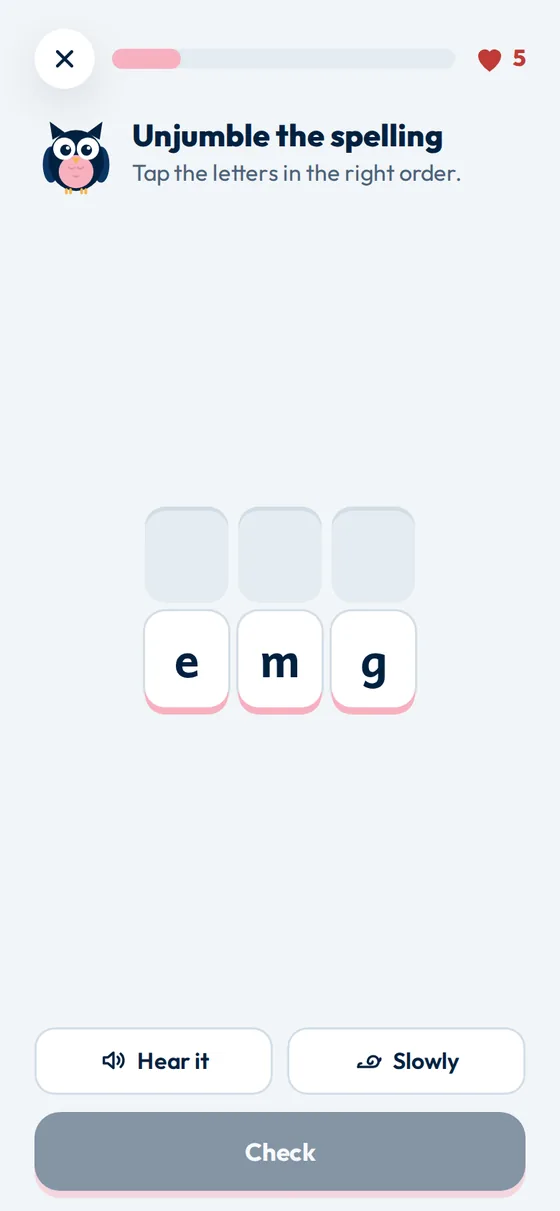
Unjumble
All the letters are there, in the wrong order. Nothing has to be recalled, because every letter is in front of them. What is being asked is whether the child knows how the word is built.
- Asks for recognition, and a sense of the word's shape
- Will not tell you whether the child could produce it from nothing
Missing letters
Most of the word is on screen and the gaps fall on the parts that are easy to get wrong. The child has a scaffold and has to fill in the difficult bit.
- Asks for cued recall, with the word partly given
- Will not tell you whether the whole word is secure
Look, cover, write, check
The classroom method on screen. The word is shown, then it is gone, then it is rebuilt from letter tiles, then it is checked.
- Asks for recall from a visual memory laid down seconds ago
- Will not tell you whether the word survives a night's sleep
Listen and spell
Nothing on screen but the tiles. The child hears the word and has to produce it with no visual prompt at all. This is the hardest of the four and the closest to what the test itself asks.
- Asks for unaided recall from sound
- The only one that counts towards mastery
The evidence
What does the research actually support?
Two ideas do most of the work here. Both are well established and neither is a Spelling Nest invention.
Retrieving beats reviewing
Being made to produce something from memory strengthens it more than looking at it again does. This is usually called retrieval practice, and it is among the better evidenced ideas in education: the Education Endowment Foundation describes it as supported by over a hundred years of research and rates it as high utility for classroom use.
This is the reasoning behind covering the word, and behind Listen and spell existing at all. A question with the word on screen is reviewing. A question with nothing on screen is retrieving.
The caveat the EEF itself raises: the effect tends to shrink as the material gets more complex, and how well it works depends heavily on how it is implemented. It is not a switch that guarantees an outcome.
Spreading practice out beats cramming
Practice distributed across days generally produces more durable learning than the same amount crammed into one session. This is the spacing effect, and it is one of the oldest findings in the study of memory. It is the reasoning behind requiring three different days for mastery rather than three correct answers in a row.
In practice it is the difference between four ten minute sessions across a week and forty minutes the night before. The total time is the same. The week is easier and the words are more likely to still be there in a fortnight.
What we measure
Practice, and whether it is actually happening.
Spelling Nest measures one thing and measures it strictly: how many of this week's words your child can spell from sound, first time, with no clues, on three different days. Not how many they got right tonight. Not how many times they tried.
It is a harder bar than most apps set, which is why progress looks slower here than it does elsewhere. It is also the number that tells you something the night before the test, which is when it matters.
At the kitchen table
What does this mean at the kitchen table?
You do not need any of the above to use the app. But if you are doing spellings without one, the same reasoning gives you four things worth doing.
Cover the word
Every time. It is the difference between reviewing and remembering, and it is the step most often skipped. How to do it properly.
Spread it across days
Four short sessions beat one long one, even when the total time is the same. Four evenings, ten minutes each, rather than one long session at the end.
Make the last attempt the hard one
If a child can only spell it with the word in front of them, they cannot spell it. Finish on an attempt with nothing to look at.
Stop when it is finished, not when the list is
Two words done properly is a better evening than ten done badly, because the evening that ends badly does not happen again the next night.
Questions
Questions about the four ways
Why does Spelling Nest ask four kinds of question instead of repeating one?
Each of the four puts the word at a different distance from the child. Unjumble asks for recognition with every letter already on screen. Missing letters asks for cued recall. Look, cover, write, check asks for recall from a visual memory laid down seconds ago. Listen and spell asks for recall from sound with no prompt at all, and is the only one that counts towards mastery.
What is retrieval practice?
Being made to produce something from memory strengthens it more than looking at it again does. The Education Endowment Foundation describes it as supported by over a hundred years of research and rates it as high utility for classroom use, while noting that the effect tends to shrink as material becomes more complex and that how it is implemented matters a great deal.
Why does Spelling Nest need three different days to count a word as mastered?
Because practice spread across days produces more durable learning than the same amount crammed into one session. Three correct answers on the same evening mostly show that a word is still in short term memory. Three across three days is a much better sign that it will still be there when it is needed.
Is a ten minute lesson really enough?
For one day, yes. A lesson is six to twelve questions and every word comes up at least once, with the words that are not yet safe coming up more often. Four ten minute sessions across a week ask more of a memory than forty minutes the night before, and the total time is the same.
Sources
Where this comes from
The Education Endowment Foundation reviewed the classroom evidence on cognitive science strategies, retrieval practice and spaced learning among them, in Cognitive science approaches in the classroom. Its own conclusion is that the laboratory evidence is stronger than the classroom evidence, which is why nothing on this page promises an outcome.
The spelling a child is expected to learn each year, and the statutory word lists behind the weekly list, are set out in National curriculum in England: English programmes of study, published by the Department for Education.
Read next
More on spelling practice at home
How to do look, cover, write, check properly at home, step by step, and the three things families most often get wrong.
Questions parents ask about Spelling Nest, including what mastered means and what the app does with your data.
Printable spelling sheets for teachers, free, with a QR code that loads the week's words at home.
Practice that actually happens.
Add this week's list, hand over the tablet, and see what has stuck before the test rather than after it. Alongside writing the words out by hand, not instead of it.