Questions
Questions parents ask
Spelling Nest is a browser based spelling app for children aged 5 to 11. A parent types in the list that came home from school, and the app turns it into a ten minute daily game. It costs £3 a month or £20 a year for the whole family, after fourteen days free. A card is needed to start.
The questions below are the ones parents ask most. If yours is not here, email info@spellingnest.co.uk and I will answer it and probably add it.
Questions
What is Spelling Nest, and who is it for?
Who is Spelling Nest for?
Primary school children, roughly ages 5 to 11, from Reception to Year 6. It suits any child who gets a spelling list to learn at home. There is nothing in it aimed at a child younger than school age.
Is there an app to install?
No. Spelling Nest opens in a browser on a phone, tablet or laptop. If you want it to feel like an app, use your browser's “Add to home screen” option and it will open full screen from an icon.
Does it work offline?
No. Spelling Nest needs an internet connection so that progress is saved to your account and is there on every device your family uses.
What devices does it work on?
Anything with a modern browser: an iPad, an Android tablet, a phone, a laptop, a school Chromebook. A tablet is the most comfortable, a phone works fine, and a laptop is fine too.
How do I sign in?
With your email address. We send you a link that signs you in, so there is no password to remember or reset. Your child never needs an email address of their own.
Questions
How do I use it at home?
How do this week's words get in?
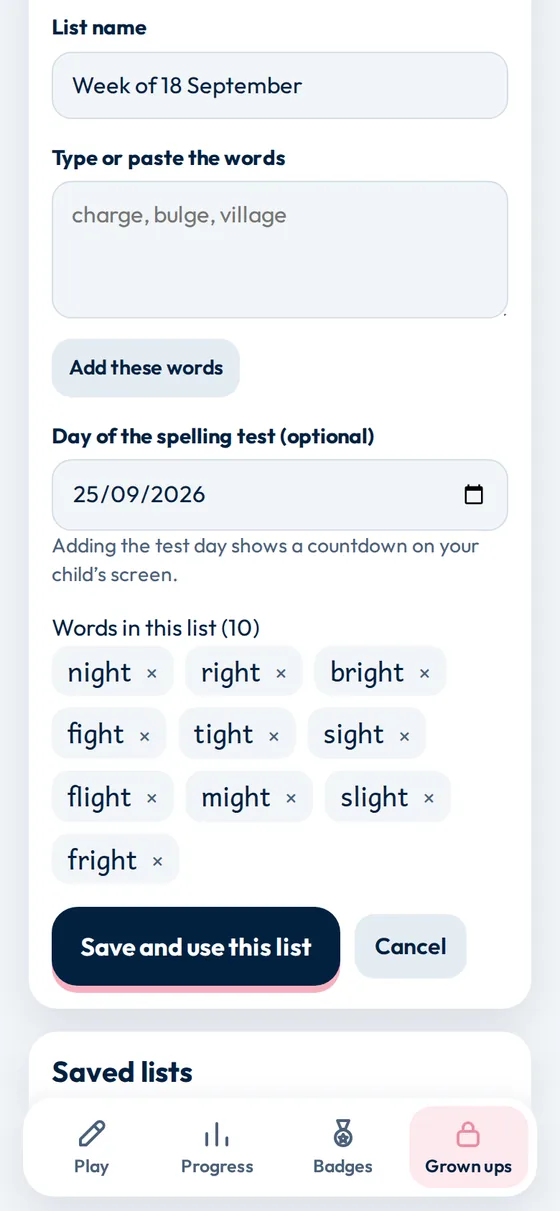
A grown up types or pastes them into the Grown ups area. The list is cleaned up automatically, so you can paste straight from a message or a photo caption without tidying it first.
Does it follow the national curriculum?
Spelling Nest does not set the words. It practises the list your child's school sends home, so it matches whatever they are being taught that week. Every new profile starts with one example list so you can try it before your next list arrives.
How long should my child play?
One lesson a day is plenty. A lesson is six to twelve questions and usually takes under ten minutes. Practice counts towards the streak on any day a lesson is finished.
Can I add more than one child?
Yes. Each child gets their own profile, their own word lists and their own progress, badges and streak, all under one grown up sign in, and one subscription covers all of them.
Does my child need to type?
No. Every answer is given by tapping letter tiles. Spelling Nest never opens a keyboard for an answer, so spelling is tested rather than typing.
What happens when my child gets stuck?
On a Listen and spell question, Kit the owl steps in without being asked: first a slow replay with each letter group lighting up, then the first letter, then the number of letters and where the tricky part sits. Words that were helped still count for XP, but not towards mastery.
What if the school sends the list as a photo?
Type or paste the words in. There is no photo import. In practice reading ten words off a photo and typing them takes under a minute, and it is the only part of the week that asks anything of you.
Questions
What does it do, and what does it not do?
What does mastered mean?
A word counts as mastered only once it has been spelled from sound, first time, with no clues, on three different days. One correct answer does not clear it off the list, and neither do three correct answers on the same evening.
Why does progress look so slow?
Because the bar is set where it is. Most apps count a word as learned the first time a child gets it right. That produces a better looking number and a worse one to rely on. The three day rule is slower on purpose.
Does it replace writing spellings out by hand?
No, and it is not meant to. Handwriting practice matters and no app changes that. Spelling Nest is designed to sit alongside the exercise book, for the days the writing does not happen.
Is it a game?
It has XP, day streaks and badges, because a child who will not open it learns nothing. But the rewards are for turning up rather than for being right, and mastery is measured separately and strictly. The rewards are not the point and the app tries not to let them become the point.
Will it teach my child spelling rules?
Not directly. Spelling Nest practises the words your child's school has set. Rules are the school's job, and teaching a rule differently from the way the class was taught it would do more harm than good.
Questions
What happens to my family's data?
What do you collect about my child?
A first name or nickname and a school year. Nothing else. No full name, no date of birth, no photograph, no location, no contact details of their own.
What do you collect about me?
Your email address, for the sign in link. The word lists you add and the lesson results sit under your account. We also count anonymous usage events so we can see which parts of the app are used.
Are there adverts?
No, and there is no third party tracking or advertising script anywhere in the app.
Where is our data kept?
In our database provider's London region.
How do I delete our data?
Open Grown ups and choose to delete all of your family's data. That removes your sign in account and email address, the children's profiles, the word lists and all progress, and it stops any subscription at the same time. You do not need to email us.
The one thing kept is the record of a payment, with your name no longer attached to it, because tax law requires us to hold it.
Can my child reach the settings?
No. The Grown ups area, where word lists and settings live, sits behind a four digit PIN.
Does the word audio leave the device?
No. Words are read aloud by your own device's built in voice, so what your child hears never leaves the device.
Questions
What do I need to know before I pay?
What does it cost?
£3 a month, or £20 for the year, which saves you £16. One subscription covers every child in your family, not one child each. New families start with a 14 day free trial, and the first payment is taken at the end of it.
Do you take my card details to start the trial?
Yes. Your card is added when you start the trial and the first payment is taken at the end of the 14 days. Nothing is taken before that.
What happens when the trial ends?
The first payment is taken from the card you added at the start, and the subscription carries on from there. If you cancel at any point during the 14 days, nothing is charged at all.
What if I cancel after I have paid?
You keep access until the end of the period you have paid for. After that the account goes read only rather than being locked: word lists, progress, streaks and badges all stay visible, and new lessons stop. Nothing is ever deleted.
Can I cancel?
Yes, in a click, at any time. Cancel during the 14 day trial and you are not charged at all. Cancel later and you keep access until the end of the period you have already paid for.
Who made it?
One person in the United Kingdom, a parent and a qualified teacher. It began with one child in this house who would do almost anything rather than sit down and write his spellings out three times. Spelling Nest is what I built to turn that ten minutes into something he would pick up on his own, alongside the writing rather than instead of it. There is no company, no investors and no advertising department.
Do any schools use it?
Not yet, we have only just started. Look, cover, write, check is the method schools use, and Spelling Nest is a way of practising it at home. If you work for a school and would like to find out more, we would be glad to talk about what a school offer could look like. Email info@spellingnest.co.uk.
Can my child's school use it?
There is no school version yet. Spelling Nest is built for families at the moment, and a version a school could buy would need a few things that do not exist today, a data processing agreement among them. If your school is interested, put them in touch at info@spellingnest.co.uk and we will talk. Teachers are very welcome to recommend it to parents in the meantime.
Something is broken. Who do I tell?
info@spellingnest.co.uk. It reaches one person, who wrote the thing, and who would rather know.
Sources
Where the method and the word lists come from
The spelling children are expected to learn in each year group, and the statutory word lists the weekly list is usually drawn from, are set out in National curriculum in England: English programmes of study, published by the Department for Education.
The Education Endowment Foundation sets out how spelling is best taught and practised at Key Stage 2 in Improving literacy in Key Stage 2.
Read next
More on spelling practice at home
How to do look, cover, write, check properly at home, step by step, and why the covering is the part that matters.
Why the same ten words are asked four different ways, and what mastered means in Spelling Nest.
Who makes Spelling Nest, and why a teacher and parent built it.
Practice that actually happens.
Add this week's list, hand over the tablet, and see what has stuck before the test rather than after it. Alongside writing the words out by hand, not instead of it.