The method
Look, cover, write, check
Look, cover, write, check is the spelling method most primary schools in the United Kingdom use. A child looks at the word and says it aloud, covers it completely, writes it from memory, then checks it letter by letter. One word takes about a minute. It is also the piece of spelling homework most often done at half speed, which is why a child can practise all week and still lose marks in the test.
This page explains how a parent can run look, cover, write, check properly at the kitchen table, in about a minute a word. It is written by Stuart Coussins, a parent and a qualified teacher, who built Spelling Nest.
The four steps
How to do each step properly
Each step asks for one thing. The method stops working when a step is done approximately.
Look
Read the word and say it out loud. Saying it matters, because it links the sound of the word to its shape on the page. This is also the moment to point at the part that is likely to catch them out: the double letter, the silent letter, the vowel that is not spelled the way it sounds.
- Say it, do not just look at it
Cover
Cover the word completely. All of it, not most of it, and not with a finger resting alongside it. A child who can still see two letters will use those two letters, without meaning to and usually without noticing. Fold the paper or turn the card over.
- If any of it is visible, it is not covered
Write
Write the word from memory, once, without peeking. Once is the point. Writing the same word three times in a row is copying from the line above, which asks nothing of the memory after the first attempt. If a peek happens, that attempt does not count.
- Once, from memory, no peeking
Check
Uncover the word and check it letter by letter, not at a glance. A glance confirms the shape and misses the vowel. If the word is wrong, write the whole word again rather than correcting the one letter, because the memory that needs fixing is the memory of the whole word.
- Letter by letter, and the whole word again if it is wrong
The part that matters
Why is the covering the point?
Covering the word is what turns the task from copying into remembering. With the word still visible, the eyes do the work and the memory is never asked for anything. It feels like practice, it fills the page, and it produces very little.
The moment the word is covered, the task changes completely. The child has to go and find the word rather than read it, and that act of retrieving is what the method is built around.
This is the reason it survives as a method. It is not the writing that does the work. It is the covering.
How often
How many times should a child practise a word?
There is no fixed number, and any page that gives you one is guessing. What matters more than the count is how the practice is arranged.
Spread it out
Four short sessions across a week ask more of a memory than one long session the night before the test. Each session starts with the word forgotten just enough to be worth remembering again. Why that works.
Two or three words at a time
Ten words in one sitting is where the evening goes wrong. A short session that gets finished is worth more than a long one that ends in an argument, because the one that ends badly does not happen again the next day.
Stop counting attempts
A word is not learned because it was written five times. It is learned when it can be produced from memory, on a different day, without the list nearby.
Where it goes wrong
What do most families get wrong?
Three things, and all of them make the practice easier than the test.
The word is not really covered
A hand over most of the word, or the list still open further down the page, is enough for a child to lean on without realising. Turn the card over or fold the sheet.
The checking is skipped
This is the step everyone drops, and it is where the learning is. A glance confirms the shape of the word and misses the vowel in the middle. Check letter by letter or do not check at all.
Only the wrong letter is corrected
Rubbing out one letter fixes the page and not the memory. If a word comes out wrong, cover it again and write the whole thing from the start.
A common question
Why does my child spell it right at home and wrong in the test?
Almost always because the practice was easier than the test. If the word was on the page, or had just been read aloud, or was written three times in a row, the memory was barely used. The child was not pretending. The practice simply asked less than the test does.
Practice that matches the test looks like this: the word covered, written once from memory, with a gap before the next attempt. It feels harder, and more words come out wrong at first. Both of those are signs it is working rather than signs it is not.
The method does not change for a child who finds spelling hard, but the size of the task should. Two words rather than ten, with the tricky part pointed out before the covering, keeps the session short enough to finish without a fight. Finishing matters more than getting through the list.
Spelling Nest
How Spelling Nest uses the method
Spelling Nest does not replace look, cover, write, check, and it does not replace writing words out by hand. It is the same method in a form a child will pick up without being asked twice, for the days when the exercise book does not come out.
The covering is built in
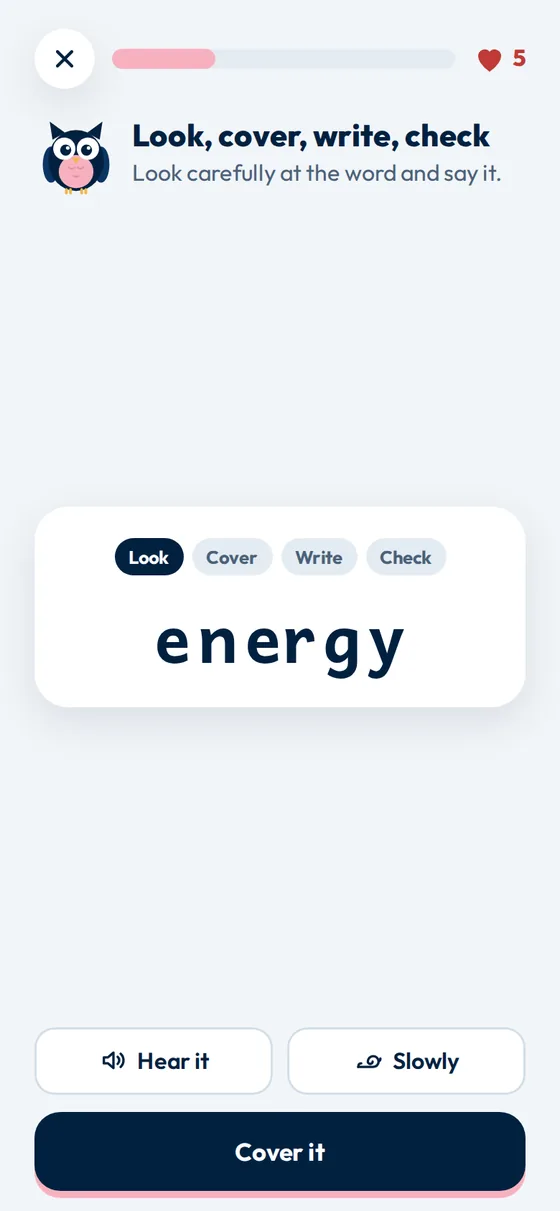
One of the four question types is the classroom method on screen: look at the word, cover it, build it from letter tiles, check it. On the Listen and spell question there is nothing on screen except the tiles, so the word can only come from memory.
Answers are given by tapping letter tiles rather than typing, so it is spelling being tested rather than a keyboard.
Mastered means mastered
A word counts as mastered only once it has been spelled from sound, first time, with no clues, on three different days. One lucky attempt does not clear it off the list.
It is a slower number than most apps report. It is also one you can believe the night before the test.
Questions
Questions about the method
What is look, cover, write, check?
Look, cover, write, check is a spelling method used in most primary schools in the United Kingdom. A child looks at the word and says it aloud, covers it completely, writes it from memory, then checks it against the original letter by letter. One word takes about a minute.
Why does the covering matter so much?
Covering the word is what turns the task from copying into remembering. With the word still visible the eyes do the work and the memory is never asked for anything, which feels like practice and produces very little. The moment the word is covered, the child has to retrieve it, and retrieving is the part that makes a spelling stick.
How many times should a child practise a spelling?
There is no fixed number. Four short sessions spread across a week ask more of a memory than one long session the night before the test, because each session begins with the word forgotten enough to be worth remembering again. Two or three words at a time is usually enough in one sitting.
What do most families get wrong with look, cover, write, check?
Three things. The word is not properly covered, so the child copies rather than remembers. The checking step is skipped or done at a glance instead of letter by letter. And when a word is wrong, only the wrong letter is corrected rather than the whole word being written again.
My child spells the word correctly in practice but gets it wrong in the test. Why?
Usually because the practice was easier than the test. If the word was on the page, or the child had just read it, or the same word was written three times in a row, the memory was barely used. Practice that matches the test looks like this: the word covered, written once from memory, with a gap before the next attempt.
Does look, cover, write, check work for a child who finds spelling hard?
The method does not change, but the size of the task should. Two words rather than ten, with the harder part of each word pointed out before the covering, keeps the session short enough to finish without a fight. Finishing matters more than getting through the list.
Sources
Where the method comes from
Spelling is statutory in England: the word lists and year group requirements sit in National curriculum in England: English programmes of study, published by the Department for Education.
For how spelling is best taught and practised in Key Stage 2, the Education Endowment Foundation sets out its recommendations in Improving literacy in Key Stage 2.
Read next
More on spelling practice at home
Why the same ten words are asked four different ways, and why a word has to be spelled correctly on three different days before it counts.
Questions parents ask about Spelling Nest, including what it costs and what it does with your data.
Printable spelling sheets for teachers, free, with a QR code that loads the week's words at home.
Practice that actually happens.
Add this week's list, hand over the tablet, and see what has stuck before the test rather than after it. Alongside writing the words out by hand, not instead of it.